
Using Construction Data Services To Scale Your Business
Construction firms are collecting more data than ever, but without a unified approach most of it goes unused. This guide shows how connected dashboards and expert data services help you move beyond reporting tools to an effective growth strategy.


Table of Contents
In an uncertain economy and a tightening construction market, contractors need real-time insights to win work, estimate accurately, and grow profitably. That’s nearly impossible to achieve when teams rely on manual reports and from-the-gut decision-making. Even software can fall short when the underlying data is inconsistent or incomplete.
Construction data services — not just reporting tools, but services that help streamline data — bridge that gap by unifying information from sales, estimating, and financials, giving contractors the visibility they need to uncover high-margin opportunities, prevent revenue leaks, and make smarter financial decisions at scale.
At TopBuilder, we built ContractorBI™ to transform forecasting from a manual, time-intensive task into a source of real-time clarity. And our Construction Data Services works side-by-side with construction firms to reconcile fragmented datasets, set up automated and secure data syncs, and ensure every report reflects accurate, decision-ready information to help you move beyond reporting tools to an effective growth strategy.
Types of Construction Data Platforms Contractors Rely On
There’s no shortage of data tools and technology, each designed to solve a specific industry problem.
- Lead-generation and bidding platforms help contractors find opportunities and manage proposals.
- Estimating and cost-data providers strengthen budgeting accuracy and competitiveness.
- Project-management and analytics tools give teams real-time insight into job costs, pipelines, and performance. Inspection and legal data platforms support compliance, risk management, and claims.
Individually, these systems add value, but most firms end up with a patchwork of programs that keeps critical information trapped in separate workflows and runs up extra costs. What they actually need is a unified source of truth that brings data together and delivers the right insight at the right moment.
Why Data Services Are More Than Reporting Tools
Your business intelligence is more than a handful of reports –– it’s the foundation of a true growth strategy. When your data is accurate and connected, it surfaces trends your organization can capitalize on, highlights risks before they become costly, and reveals opportunities that move the business forward.
This shifts your teams from reactive problem-solving to proactive management grounded in real-time insight. With the right information at the right moment, you can make decisions that not only track revenue but help scale it.
Growth Benefits of Using Construction Data Services
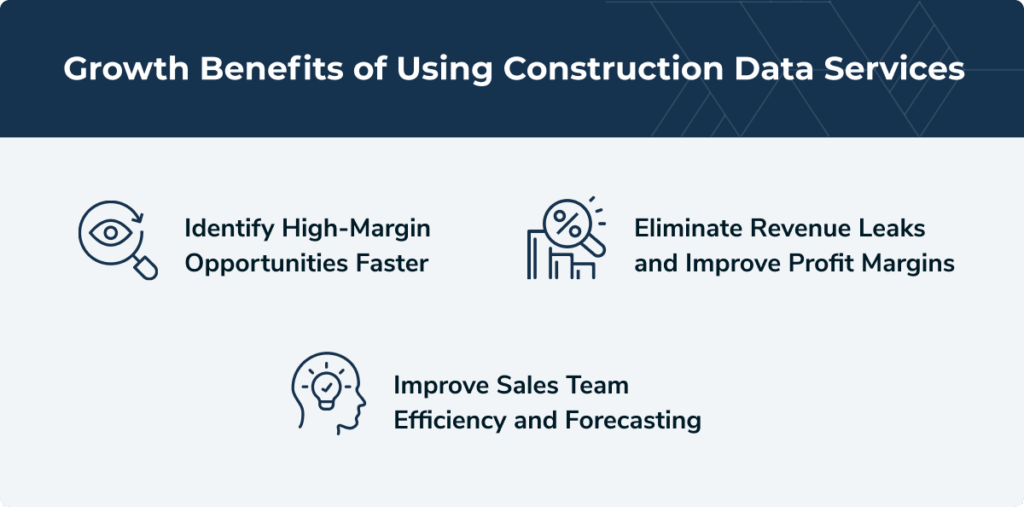
Software tools, even platforms built for construction companies, are only as effective as the data they’re using. Unified data is essential to getting the insight that make the tools worth using. Unified data helps you:
1. Identify High-Margin Opportunities Faster
Without unified data, it’s nearly impossible to understand which jobs, customers, or markets consistently deliver the strongest returns. A connected system allows you to track win rates by job type, customer, and estimator so you can focus on the work that pays best.
You’ll be able to prioritize bids with higher profit potential and compare performance across markets or divisions. ContractorBI takes this a step further by allowing you to filter dashboards to quickly spot patterns in successful bids and target the opportunities most likely to drive growth.
2. Eliminate Revenue Leaks and Improve Profit Margins
When financial, estimating, and project data live in separate systems, small issues can snowball into lost revenue before anyone notices. Unified reporting gives teams real-time visibility into budget vs. actuals, helping them spot underperforming jobs or divisions early and take corrective action.
This reduces cost overruns, margin erosion, and the hidden leaks that often slip through the cracks. As a full-service provider, ContractorBI brings sales, estimating, and accounting data into one dashboard so you can prevent problems instead of reacting to them.
3. Improve Sales Team Efficiency and Forecasting
Siloed sales and operations data makes it difficult to understand pipeline health, production capacity, or the true profitability of incoming work. A unified platform enables teams to track pipeline by stage, estimator, or division, align sales efforts with operational capacity, and score leads based on size, likelihood, and margin potential.
Many tools can generate leads, but few provide the analytics needed to act on them intelligently. ContractorBI paired with TopBuilder gives contractors both a CRM and BI solution to ensure teams not only capture more opportunities but pursue the right ones.
How ContractorBI by TopBuilder Makes It Easy
Thirteen percent of construction teams’ working hours are spent looking for project data and information because they’re using siloed and static systems. If that sounds painfully familiar and you’re ready to equip your team with the resources to work smarter, not harder, TopBuilder offers the support you’ve been missing.
Unlike generic BI tools (like Power BI) that are cluttered and slow to implement, TopBuilder delivers a full-service experience designed around real drivers of construction growth.
ContractorBI delivers out-of-the-box dashboards purpose-built for contractors, eliminating hours of configuration and immediately surfacing tailored insights that matter to your stakeholders. It also connects to your CRM — whether you use TopBuilder’s CRM or another platform — with bid tracking, project performance, and financial data to create a single cube for the metrics your teams rely on. These dashboards reveal high-margin trends, strengthen estimating accuracy, clarify pipeline health, and improve job cost forecasting so decisions are rooted in reality, not guesswork.
To ensure every report is accurate and reliable, our Construction Data Services team handles the heavy lifting of cleaning, hosting, and maintaining your data so that timely, trustworthy insights are always at your fingertips.
Getting Started With Construction Data Services
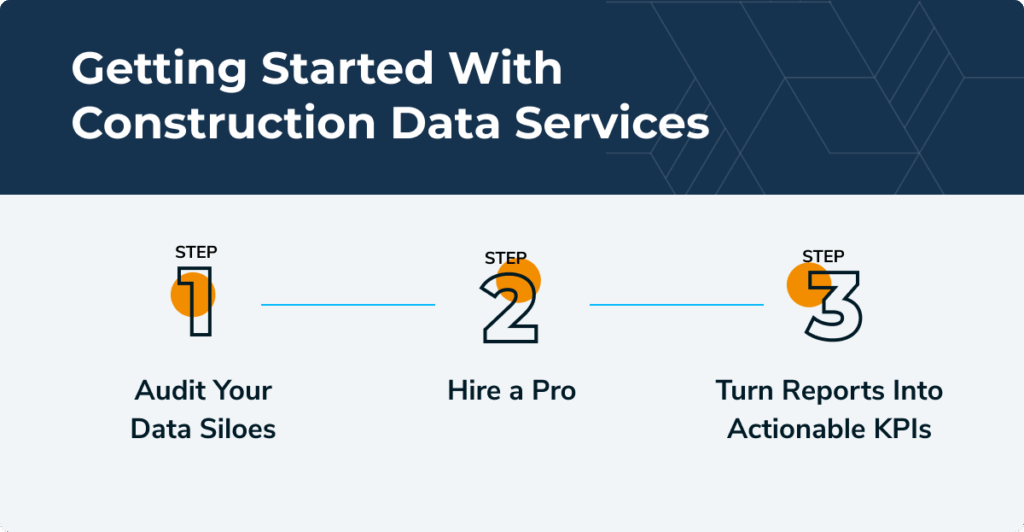
If you’re ready to invest in construction data services, here are the steps you can take to ensure that you implement a platform your stakeholders will actually adopt.
Step 1: Audit Your Current Data Siloes
Start by taking inventory of the systems your teams rely on for lead generation, bidding, estimating, job costing, and forecasting. Understanding where each dataset lives — and how disconnected those sources are — reveals the gaps that slow teams down and the opportunities a unified platform can unlock.
Step 2: Hire a Pro To Help With Data Preparation & Consolidation
Many software platforms demand extensive setup from your IT team — time that could be better spent supporting more important projects. TopBuilder’s Construction Data Services team delivers a white-glove implementation of ContractorBI, handling the configuration, data cleanup, and integration work so your dashboards are accurate, reliable, and ready to use from day one.
Step 3: Turn Reports Into Actionable KPIs
Equipped with dedicated support and clean data, you can start turning reports into KPIs that directly support growth, such as gross margin by job type, estimator win rate, and sales pipeline velocity. Build a habit of reviewing these metrics weekly so teams can spot shifts early and take action with confidence.
FAQs: Construction Data Services for Contractors
What’s the difference between a data service and a dashboard tool?
A data service is dedicated support from a team of experts to clean and reconcile your data from different business functions such as sales, estimating, and financials, while a dashboard tool presents that clean data as actionable insights.
Do I need to replace my current tools (CRM, ERP)?
No, you don’t necessarily need to replace tools you’re already using. ContractorBI integrates with leading solutions like Sage, Procore, Acumatica and others to improve visibility and collaboration across teams without requiring a complete overhaul of your existing tech stack.
How quickly can I get started with a data platform like ContractorBI?
TopBuilder offers a free 14-day trial to help you view the benefits immediately, not a few months from now, no credit card or commitment required. In the trial, real customer sample data will show you what the software is capable of. And when you’re ready to sign up, you can simply book a call with the team to get started.
Grow Smarter With Construction Data Services
Data shouldn’t be treated as a reporting afterthought; it’s the fuel that sparks better decisions. Analytics can be your growth engine if you invest in the right tools and services to help your team make smarter decisions.
ContractorBI is the easy-to-use construction-specific tool that helps contractors unify data, surface insights, and scale with confidence. And with TopBuilder’s Construction Data Services, your team can ramp quickly to see results right away.
Start your 14-day free trial today, or book a demo to learn more.
Related Content

How To Get on a General Contractor’s Bid List (and Stay There)

Construction Business Development: Managing Client Expectations with Technology