
Understanding Your Construction Industry Profit Margin: Tools To Identify Revenue Leaks
Monitoring the profit margin on every construction project is good practice and essential for identifying profit leaks and supporting long-term profitability. Let’s look at why profit margins matter in the construction sector and how technology can help you identify losses and capitalize on opportunities.



Table of Contents
Monitoring the profit margin on every construction project is good practice and essential for identifying profit leaks and supporting long-term profitability. Let’s look at why profit margins matter in the construction sector and how technology can help you identify losses and capitalize on opportunities.
Guessing at your bottom line is never a good idea, especially in construction. You might think a project went perfectly, but your net margin was razor thin, or you even ended up in the red. Or maybe it seemed like everything that could go wrong did go wrong, but it didn’t have as much of a financial impact as you feared.
With a construction software tool like TopBuilder and ContractorBI™, featuring powerful analytics and reporting features, you can streamline this process and focus on boosting your construction profit.
Why You Should Monitor Construction Profit Margins
Building projects have higher stakes and tighter margins than most industries. With rising total project costs for labor and materials, even a slight misstep in construction estimates or execution can lead to significant erosion in both gross and net profit. That’s why it’s important to identify areas to stop revenue leaks from eating into average profit.
Average Profit Margins for Construction Companies
Depending on the year, profit margin industry averages can change, and not all contractors operate at the same margin. In the U.S., general contractors average around 5 to 6 percent net income before taxes, while specialty trades run higher at roughly 6.9 percent, according to the Construction Financial Management Association’s 2025 Financial Benchmarker.
Meanwhile, estimates from financial institutions and lenders generally put construction net profit margins in the 2 to 8 percent range, whether you’re a general or a specialty subcontractor. Specialty firms compete on licensed expertise rather than price, which insulates their margins. Top performers across both categories reach approximately 12 percent net income before taxes.
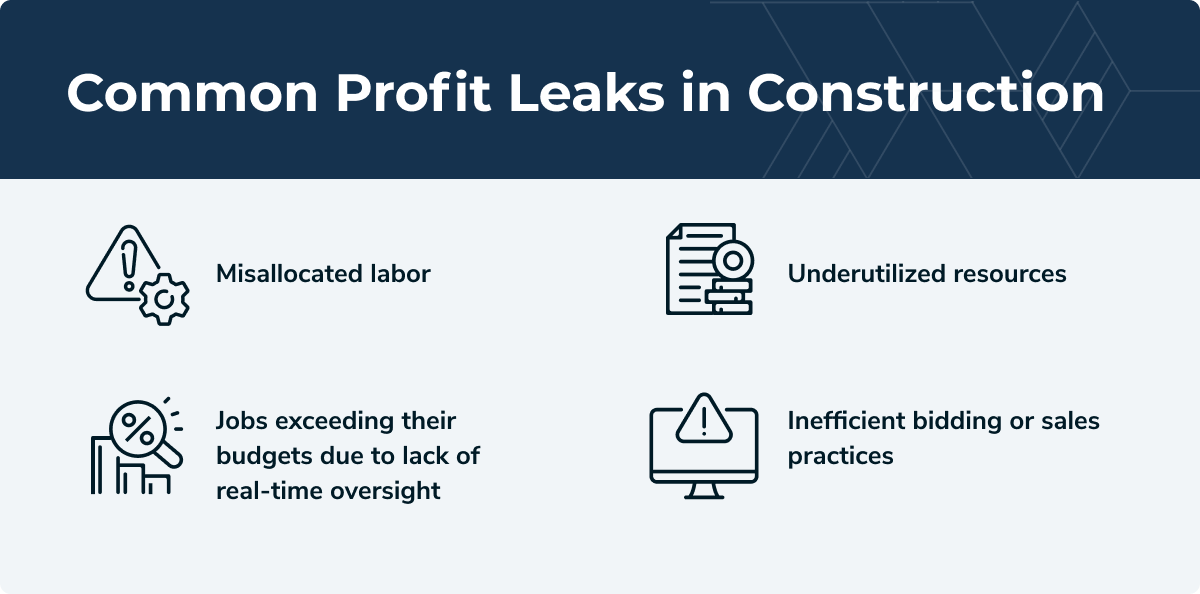
Revenue leaks eat into your profit margin. They’re the hidden losses that drain from your business due to inefficiencies, errors, or overlooked details in your job costs and direct costs. Unfortunately, they’re often subtle, compounding over time until they significantly impact your bottom line.
Common profit leaks in construction include:
- Underestimated labor costs
- Higher material costs and equipment rentals than originally scoped
- Failing to fully account for indirect costs like office rent, legal fees, and other overhead costs
- Underestimating subcontractor fees and direct project costs
- Missing or under-tracking indirect expenses tied to pre-construction and estimating
Dealing with these issues can be tricky — the causes are not always obvious! But with the right tools, you can fix the problem and end up in a better position than you started.
The First Step To Improve Construction Profit Margins
Understanding how much revenue is actually left after direct costs, operating costs, and overhead expenses is the first step. The two numbers to know are gross and net.
- Gross profit margin is revenue minus the cost of goods sold, divided by revenue, times 100.
- Net profit margin takes it further by pulling overhead out too: (Revenue − COGS − Overhead) ÷ Revenue × 100.
Many contractors know their total revenue but struggle to calculate construction profit margins accurately across multiple projects, where each project type carries different risk profiles and cost structures. Margins also swing widely by project type. Specialty trades tend to earn more, since deeper expertise and thinner competition give them room the broader market doesn’t have.
Margin monitoring does more than fix problems. The same insights build smarter estimating and bidding habits that lift profits on future projects.
Construction Software Manages and Improves Your Gross Profit Margins
Construction software is a significant advantage when it comes to understanding and protecting your gross profit margin. Healthy margins starts with these three things.
1. Centralized Data for Greater Visibility
If you can’t see key financial metrics for your business, you can’t accurately improve construction profit margins. Using software like TopBuilder will consolidate data from sales, bidding, project management, and accounting into a single platform. This provides a comprehensive view of where your profits are coming from and where they’re leaking through gaps in actual costs versus estimates. Or in how operating expenses are tracked across the business.
2. Real-Time Monitoring To Stay on Track
When you can track ongoing construction project performance against initial estimates, you can address potential issues before they escalate. Business intelligence dashboards like those in ContractorBI allow you to compare actuals to estimates and monitor gross margin at the job level, keeping you informed at every stage of the project.
3. Insights for Better Decision-Making
Analytics can reveal trends and highlight areas for improvement, such as underperforming job types or inefficiencies in how hard costs and soft costs are being managed. ContractorBI provides visibility across key parameters and lets you pinpoint what is working and what needs immediate attention — including hidden opportunities (revenue gaps) that top performing contractors use to maximize their margins.
How To Identify Revenue Leaks and Respond Quickly
If you want to plug a leak, you have to know where it is. With ContractorBI, you can quickly pinpoint problems and take action.
Spot Inefficiencies With Targeted Analysis
ContractorBI’s dashboards let you analyze performance by sales agent, job type, lead source, and more. For example, if you notice that projects from a specific lead source consistently underperform on net profit, you can revisit your bidding strategy to address the issue before it impacts your bottom line further. Stopping a leak is great, but it’s even better to prevent it in the first place.
Address Early Warning Indicators and Key Performance Indicators
Use job cost performance reporting to spot revenue and profit leaks during construction. Tracking the percentage difference between the project budget and actual costs is one of the key performance indicators that gives construction leaders the visibility they need to course-correct before issues compound. Make net profit margin a monthly review at the very least — the longer the gap between checks, the more time a problem has to grow before it surfaces.
Suppose you’re three months into a six-month build and mid-project labor costs exceed estimates by 10 percent. Data-driven insights allow you to dig deeper into what’s causing the overages — whether it’s higher-than-expected overtime, unexpected delays, or higher material costs than anticipated. Having real-time data gives you power over your next steps, so you can quickly respond to minimize further impact and keep cash flow healthy.
Discover Untapped Opportunities
Revenue leaks aren’t always about losses. They can also represent missed opportunities.
ContractorBI helps you spot revenue gaps that signal untapped potential from your construction costs, such as underutilized teams or overlooked markets. For instance, you might discover a specific area is consistently delivering profitable projects but has fewer bids submitted. Knowing where to bid is often as savvy as knowing how to bid.
Improve Operational Efficiency To Protect Your Margins
In project management, a proactive approach beats reactive management every time.
The proactive construction company owner or project manager makes decisions and plans based on clearly defined revenue goals and is always looking for new opportunities. A reactive one waits for a problem to surface — or is too busy to address matters before they become problems — and then deals with it the best they can. The right tools give you the insights needed to anticipate issues and make informed, proactive decisions.
- Forecast challenges: ContractorBI’s workforce utilization dashboard helps you predict labor shortages and plan accordingly, preventing margin erosion and helping you better manage monthly overhead.
- Benchmark for growth: Use AI-powered benchmarking to compare your profit numbers against industry benchmarks, setting reasonable profit goals and tracking progress. General contractors and specialty contractors alike make more informed decisions when they know where they stand relative to peers.
- Reduce overhead and close revenue gaps: Analytics help you identify where to invest resources — whether it’s targeting high-potential regions, improving how you track indirect expenses, or boosting underperforming job types.
All these advantages help you keep the business running efficiently while closing revenue gaps and optimizing operations within your specialty. This could mean improving resource allocation for specific project types, expanding the geographic areas you serve, or capitalizing on trends within your area of expertise to secure more lucrative opportunities.
Understanding gross and net profit margin across multiple projects can’t be waved off simply as an accounting exercise; it’s how construction leaders make smarter decisions about where to bid, what to charge, and how to grow sustainably.
Profit leaks are a silent threat to any construction business, but with TopBuilder, they’re not insurmountable. Schedule a demo today to take control of your profit margins and identify hidden opportunities.
Related Content

How To Choose the Best CRM for Construction Companies

Top 20 CRM Integrations to Help Automate and Grow Your Subcontractor Business